AI Product Photography for Furniture Brands: The Complete Guide
By the ORA Lab team · Updated 1 August 2026 · 10 min read
Key takeaways
- AI product photography lets a furniture brand turn one catalog photo of a piece into styled room scenes, living rooms, lofts, bedrooms, without trucking furniture to a set.
- Furniture shoots carry costs other categories don't: freight, set construction, and staging. That's why savings from AI are often larger here than in any other product category.
- AI room scenes differ from 3D rendering: no modelling pipeline, no per-SKU setup cost, and photorealistic output in hours, but less camera-angle control than a full 3D scene.
- 'Virtual staging' tools are built for real-estate listings, not furniture commerce. Brands need product-first tools where the furniture stays exactly accurate, not approximately similar.
- Material fidelity, wood grain, upholstery weave, leather texture, is the quality bar that separates commerce-grade AI tools from generic image generators.
Furniture photography has a logistics problem no other category quite matches. The product is heavy, bulky, and scratches if you look at it wrong. Shooting a sofa in a styled room means either building that room in a studio, set walls, flooring, props, lighting rig, or freighting the sofa to a location and hoping the light cooperates. Either way you've spent serious money before a single frame is captured, and you'll spend it again next season when the aesthetic changes.
This is why lifestyle imagery has always been a luxury for furniture brands: the big players shoot rooms, everyone else crops the same white-background pack shot into every channel and hopes for the best. AI product photography changes that economics completely. This guide explains how it works for furniture specifically, what it costs against both studio shoots and 3D rendering, and what to check before trusting a tool with your catalog.
What AI product photography means for furniture
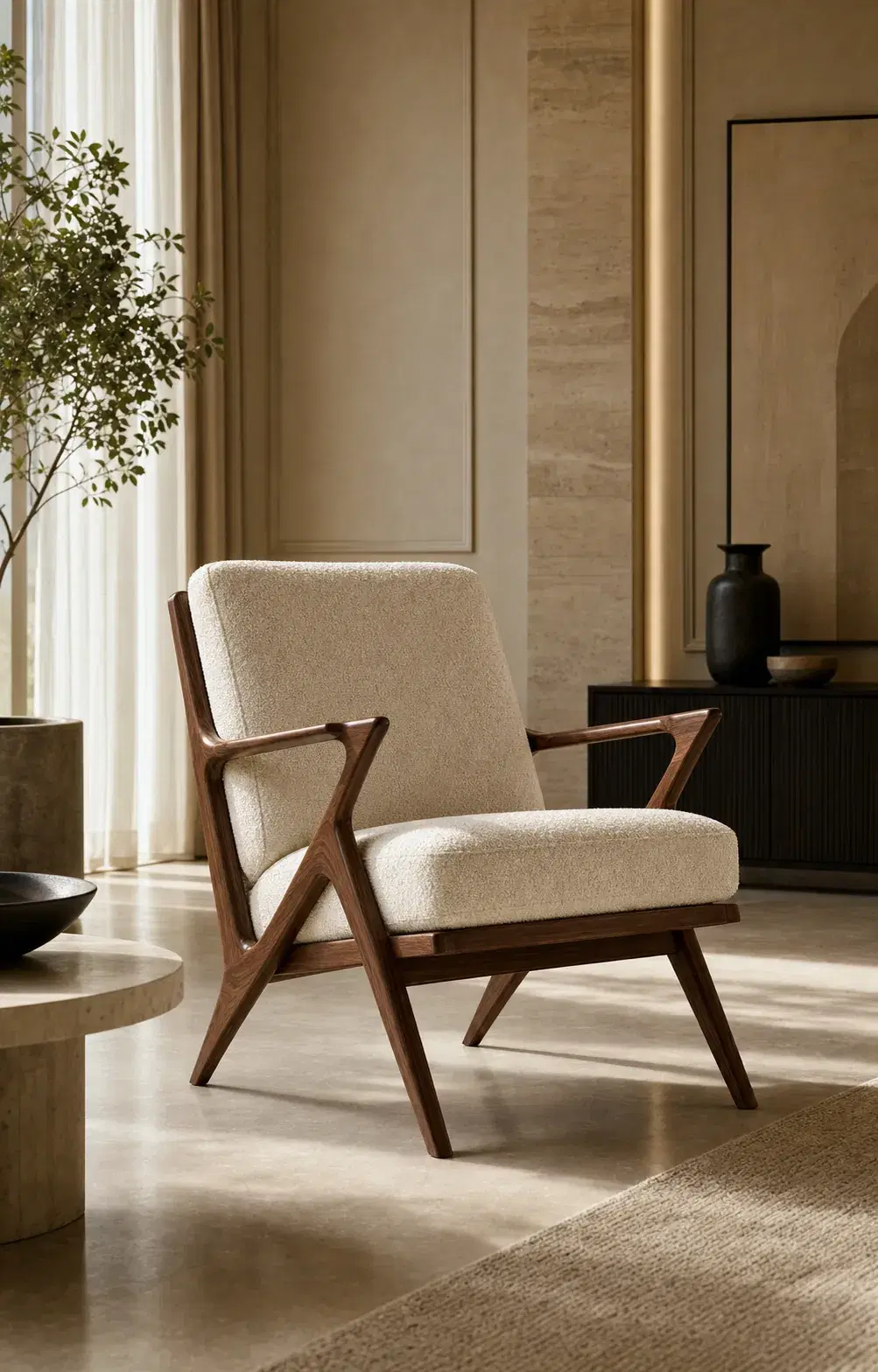
The workflow starts from photography you almost certainly already have: the plain, white-background catalog shot of each piece. An AI model trained for product imagery takes that photo and generates the piece inside a fully styled scene, a Scandinavian living room, an industrial loft, a warm bohemian reading corner, with correct perspective, scale, floor contact, shadows, and lighting that matches the room.
Done right, the piece itself never changes. The oak stays that oak; the bouclé stays that bouclé. What changes is everything around it. One lounge chair photographed once can appear in a dozen rooms, each targeting a different customer, channel, or season.
AI scenes vs 3D rendering vs studio: picking the right tool
Furniture is unusual in having three viable routes to lifestyle imagery, and most content about AI photography ignores the one big brands already use: 3D rendering. IKEA famously renders much of its catalog. So the honest comparison is three-way.
| Studio / location shoot | 3D rendering (CGI) | AI generation | |
|---|---|---|---|
| Setup per SKU | Freight + staging per shoot | 3D modelling per SKU (hours, days each) | One existing catalog photo |
| Cost profile | High per shoot, recurs each season | High upfront, cheap per image after | Low upfront, low per image |
| Turnaround | Weeks | Weeks to build library, then fast | Hours |
| Photorealism | Perfect (it's real) | Very high with skilled artists | Very high with domain-trained models |
| Camera/angle control | Full | Full | Partial, scene-level direction |
| Best fit | Hero campaigns, flagship pieces | Huge stable catalogs with 3D teams | Fast-moving catalogs without CGI pipelines |
The rule of thumb: if you already have a 3D pipeline and thousand-SKU stability, CGI keeps earning its keep. If you're a growing brand whose catalog changes every quarter and whose lifestyle imagery is currently 'the white background shot again', AI generation gets you to styled rooms this week, without hiring a 3D team.
A note on 'virtual staging', it's not the same thing
Search for AI room tools and you'll mostly find virtual staging apps aimed at estate agents: they furnish an empty property photo with plausible-looking furniture to help sell the house. Useful for realtors, wrong tool for brands, because the furniture in those renders only needs to look nice, not be a real product someone can buy. Furniture commerce needs the opposite: the room can be invented, the product cannot. If a tool can't guarantee your actual SKU appears in the scene, same legs, same fabric, same proportions, it's a staging toy, not a product photography system.
Where the savings actually come from
- No freight and handling: the single biggest line item unique to furniture shoots disappears, nothing is shipped, insured, assembled, or touched up after transit.
- No set construction: a styled room that would take a crew two days to build is a generation parameter.
- No seasonal re-shoots: when the autumn campaign needs warmer wood tones and evening light, you regenerate rather than re-stage.
- Channel coverage from one source: marketplace crops, category banners, social formats, and A/B variants all come from the same catalog photo.
- Room-style testing: run the same sofa in five aesthetics and let click-through data tell you which room sells it before committing campaign spend.
Furniture brands we work with typically start with exactly this move: take the existing white-background catalog, generate styled scenes for the top-selling 20% of SKUs, and measure. The catalog looks transformed in a week, and the shoot budget that remains goes to a handful of true hero images.
The quality bar: materials, scale, and light
Furniture has its own fidelity traps, different from jewellery's but just as commercially important. Wood grain must flow continuously across surfaces, generic models produce grain that changes direction at panel edges, which any furniture buyer clocks instantly. Upholstery weave has a scale; if the boucle loops render twice actual size, the piece looks like a toy. Proportions must survive perspective: a 2-metre sofa that reads as 1.6 metres in a room scene will generate returns from buyers who measured their wall.
Scale accuracy is worth dwelling on, because it's furniture's version of jewellery's prong-count problem: the detail that turns a pretty image into a misrepresented product. Our approach at ORA, grounding generation in the geometry of the source piece, covered in more depth in our research on product fidelity, exists precisely because 'looks nice' and 'is accurate' are different standards, and commerce requires both.
Evaluating a tool: the furniture-specific checklist
- 1.Test with a patterned or textured piece, a striped upholstery or visible-grain oak, and inspect texture continuity at seams and edges.
- 2.Check floor contact and shadows: pieces that 'float' a few millimetres above the floor are the most common giveaway of weak compositing.
- 3.Verify scale against room context: does the piece read at its true dimensions next to a door frame or window?
- 4.Generate the same SKU in three different room styles and confirm the product is identical across all three.
- 5.Look at reflective and glass elements, table tops, metal legs, under different scene lighting.
- 6.Batch test: 20 SKUs through the tool, not one. Consistency at volume is the actual product.
If you'd rather run that checklist on our output than a vendor's promises, with a few of your own catalog photos, including whichever piece you think will break it.
Frequently asked questions
- Can AI put my actual furniture into a styled room scene, or does it invent similar-looking furniture?
- Commerce-grade tools preserve your actual product, same materials, proportions, and details, and generate only the room around it. Virtual staging apps built for real estate do the opposite: they invent plausible furniture. For selling real SKUs, only the first approach is usable.
- Is AI generation better than 3D rendering for furniture?
- They solve different problems. 3D rendering suits large, stable catalogs with in-house CGI pipelines, high setup cost per SKU, cheap images after. AI generation needs no modelling: it works from an existing catalog photo and produces scenes in hours, which suits fast-changing catalogs and brands without 3D teams.
- What input photos do I need for AI furniture photography?
- The white-background catalog shots you already have are usually sufficient, sharp, evenly lit, and showing the piece squarely. An additional angle helps for complex silhouettes.
- How much does furniture lifestyle photography cost traditionally?
- A styled room shoot involves freight, set construction or location hire, staging, and crew, commonly thousands of dollars per scene before retouching, which is why most brands historically limited lifestyle photography to a few hero pieces. AI generation removes freight and set costs entirely and prices per image at a small fraction of that.
- Will the generated scenes work for marketplaces like Amazon or Wayfair?
- Yes, lifestyle imagery is standard on marketplace listings, and AI-generated scenes are acceptable so long as the product itself is represented accurately. Check each marketplace's current imagery policy for format specifics like background requirements on the primary image.