AI Product Photography for Jewellery Brands: The Complete Guide
By the ORA Lab team · Updated 1 August 2026 · 11 min read
Key takeaways
- AI product photography turns a basic product photo of a jewellery piece into campaign-quality imagery, on models, in styled scenes, at catalog scale, without a physical shoot.
- A traditional jewellery campaign shoot typically runs $8,000, $40,000 and takes 3 to 6 weeks; AI generation produces comparable creative in hours at a small fraction of the cost.
- The single most important thing to evaluate in any AI tool is product fidelity: stone count, prong geometry, metal colour, and setting must match the real piece exactly.
- Generic image models fail on jewellery because they don't understand how light behaves inside a gemstone. Domain-trained models exist specifically to fix this.
- Good inputs matter: a sharp, well-lit product shot against a plain background is all most AI tools need to work from.
Jewellery is probably the hardest product category to photograph well, and every brand that has sat through a campaign shoot knows it. A ring is small, mirror-finished, and full of surfaces that pick up every light source in the room, including the photographer. Diamonds read as grey lumps under the wrong light. Polished gold turns into a funhouse mirror. And the moment you put a piece on a model, you've added hair, skin tone, wardrobe, and a stylist's day rate to the problem.
So it isn't surprising that jewellery brands were among the first to take AI product photography seriously. When the traditional route costs this much and moves this slowly, the incentive to find another way is real. This guide covers how AI product photography actually works for jewellery, what it costs compared to a studio shoot, where it genuinely shines, where it still falls short, and how to evaluate the tools, including the questions most vendors hope you won't ask.
What is AI product photography for jewellery?
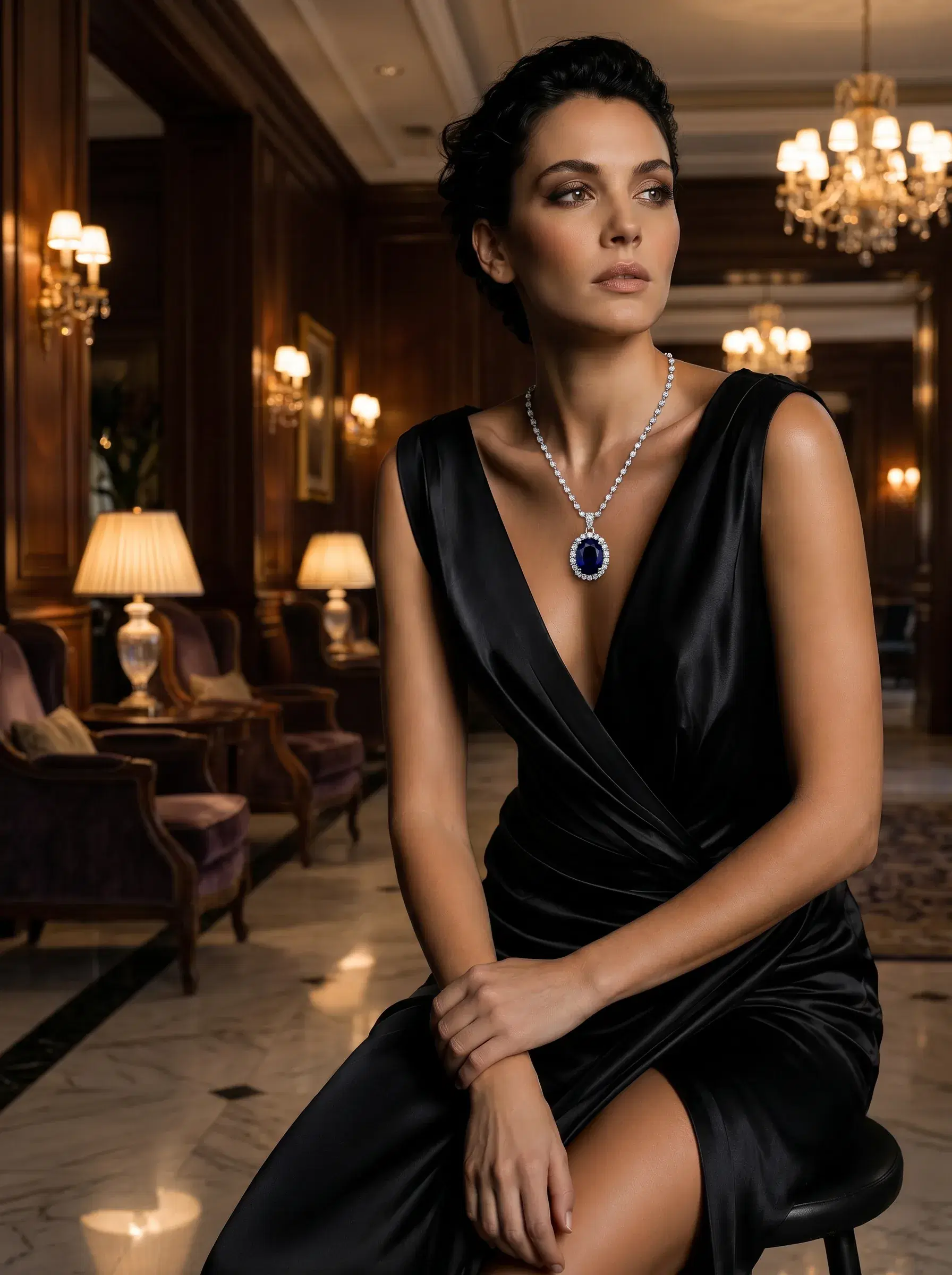
AI product photography is the use of generative image models to create finished, campaign-ready photographs from a simple product image. For jewellery, that means you photograph a necklace once, even on a plain white background with a phone, and generate the rest: the piece worn by a model, styled into an editorial scene, lit like a luxury campaign, varied across cultures and settings for different markets.
The important distinction is between generation from scratch and generation from a real product. Tools that invent jewellery from a text prompt are design tools, fun, but useless for selling a real SKU. Commerce-grade AI photography starts with your actual product photo and preserves it through every transformation. The scene changes; the piece doesn't.
Why jewellery breaks generic AI image tools
If you've tried running a ring through a general-purpose image model, you've seen the failure modes already. An extra prong appears. A six-stone band becomes a five-stone band. Rose gold drifts toward yellow. The refraction inside the stone, the thing that makes a diamond look like a diamond rather than glass, goes flat or turns to noise.
This happens because generic models are trained on everything, and jewellery physics is a rounding error in their training data. Light transport through a faceted gemstone is genuinely complicated: light enters, bounces internally between facets, and exits at angles that depend on the exact cut geometry. General models approximate this with 'sparkly texture'. Domain-trained models, trained specifically on jewellery imagery, with conditioning that anchors output to the source geometry, treat it as a constraint that cannot be violated. That constraint-first architecture is the foundation we built ORA on, and it is why the stone count survives generation.
The cost picture: studio shoot vs AI
Numbers vary by market and production level, but the shape of the comparison is consistent. A professional jewellery campaign shoot involves studio hire, a photographer who specialises in macro and reflective work, model fees, hair and makeup, styling, insurance for transporting the pieces, and a retouching cycle that can run longer than the shoot itself. For a full campaign, brands commonly spend between $8,000 and $40,000, and wait three to six weeks for final files.
| Traditional studio shoot | AI generation | |
|---|---|---|
| Upfront cost | $8,000, $40,000 | Subscription or per-image fees, typically 90%+ lower |
| Turnaround | 3 to 6 weeks including retouching | Hours |
| Images produced | 6 to 30 hero shots | Effectively unlimited variations |
| Logistics | Ship and insure the pieces, book studio, model, stylist | Upload one photo per SKU |
| Reshoots | New booking, new budget | Regenerate at marginal cost |
| Seasonal refresh | Full new production | New scenes from the same source images |
The deeper change isn't the line-item saving, it's what becomes possible when the marginal cost of an image approaches zero. A brand that could afford six hero images a season can now produce sixty: different models, different cultural aesthetics for different markets, seasonal variants, marketplace-specific crops. Campaign creative stops being a scarce resource you ration and becomes something you iterate. For a detailed cost breakdown, see our companion piece on the real cost of jewellery photography.
What AI jewellery photography does well today
- On-model imagery: placing a necklace, earrings, or ring on a photorealistic model with correct scale and anchoring, earlobe, clavicle, finger, without booking anyone.
- Editorial scenes: the piece in a styled environment, from Riviera terrace to heritage-wedding mandap, matched to the market you're selling into.
- Catalog scale: shooting one collection the traditional way is a project; generating consistent imagery for 200 SKUs is a batch job.
- Campaign variation: the same piece rendered across multiple aesthetics, minimal studio, floral outdoor, festive, to test what converts before committing a season's budget.
- Video: motion output from still product images, a model turning, light moving across a stone, for reels and product pages.
Where it still falls short, and where a studio wins
Honesty helps here, because vendors in this space tend to oversell. Extreme macro work, the shot where a single melee diamond fills the frame, still favours a specialist photographer with a focus rail. Certified stones photographed for authentication or insurance need real photography, full stop. And if your brand identity is built around a specific muse or celebrity face, AI models can't replace a person you've contracted precisely because of who they are.
The practical pattern we see with the leading jewellery houses we work with isn't studio versus AI as an either/or. It's a smaller, sharper studio budget for the handful of images that truly need physical production, with AI covering the long tail: catalog, campaign variants, marketplace imagery, social, and every market-specific adaptation that never used to justify its own shoot.
How to evaluate an AI jewellery photography tool
- 1.Run your hardest SKU through it, a pavé band or a multi-stone chandelier earring, not a plain cabochon pendant. Count the stones in the output. Count them again.
- 2.Check metal colour under varied scene lighting. Rose gold should stay rose gold in a candlelit scene.
- 3.Look at the anchor points on model shots: does the earring hang from the lobe or float near it? Does the ring sit at the base of the finger?
- 4.Ask how the tool preserves product identity across generations, if the vendor can't explain their approach to fidelity, assume they don't have one.
- 5.Test at your real scale. Ten images in a demo is not two hundred SKUs on a deadline.
- 6.Check output resolution and licensing terms against your actual usage: marketplace listings, out-of-home, and paid social have different needs.
Preparing your product images: a 5-minute checklist
Every AI tool is downstream of its input. The good news: the input bar is low compared to finished photography. You need a clear record of the piece, not a beautiful one.
- Shoot against a plain, neutral background, white or light grey. Avoid busy surfaces and coloured casts.
- Use diffuse, even light. Near a large window works; harsh direct light creates blown-out highlights the model can't see past.
- Get the piece sharp and large in frame. A phone camera is fine; a blurry phone photo is not.
- Capture the piece square-on in its 'catalog orientation', plus one angle shot if the design is three-dimensional.
- Keep reflective surfaces clean, fingerprints on polished gold survive into generations.
That's genuinely it. The heavy lifting, lighting design, scene construction, model, mood, moves to the generation side. If you want to see what that looks like with your own pieces, and bring your most difficult SKU; it's a better test than any showreel.
Where this is heading
The research frontier is moving toward tighter physical grounding: models that reconstruct a piece's 3D geometry and material properties from photos, then guarantee the render matches it, the direction our own lab is pushing in ORA's research on commerce visuals. Virtual try-on is the other axis: letting a shopper see a specific piece on themselves before purchase, which early adopters are finding reduces returns for the simple reason that buyers know what they're getting. Both point at the same destination, imagery that is generated, but never invented.
Frequently asked questions
- Can AI really keep my jewellery accurate, stones, prongs, metal colour?
- Only domain-trained tools can, and it's the first thing you should test. Generic image models routinely change stone counts and drift metal colours. Purpose-built jewellery models condition generation on the source product's geometry and materials, so the piece in the output matches the piece you sell. Test with your most complex SKU before trusting any tool.
- How much does AI jewellery product photography cost compared to a studio shoot?
- A traditional jewellery campaign shoot typically runs $8,000, $40,000 and takes 3 to 6 weeks. AI generation is usually priced as a subscription or per-image and comes in 90% or more below studio cost, with hours instead of weeks of turnaround. Exact pricing varies by tool and volume.
- What input photos do I need?
- One sharp, well-lit photo per piece against a plain background, a phone camera in good window light is sufficient. An extra angle helps for three-dimensional designs. You don't need professional photography as input; that's the point.
- Is AI-generated jewellery photography legal to use in ads and marketplaces?
- Yes, provided the imagery accurately represents the product being sold, the same standard that applies to retouched photography. The risk isn't that the image is AI-generated; it's inaccuracy. This is why product fidelity matters more than any other feature.
- Will AI replace jewellery photographers?
- For catalog volume and campaign variations, largely yes, that work is already moving. For extreme macro, certification photography, and shoots built around a specific person, real photography still wins. Most brands land on a hybrid: a smaller studio budget for what truly needs it, AI for everything else.