Jewellery Photoshoot Cost in India (2026): Studio vs AI
By the ORA Lab team · Updated 1 August 2026 · 9 min read
Key takeaways
- In India, professional jewellery photography typically costs ₹200, ₹800 per image for e-commerce work, ₹15,000, ₹80,000 per shoot day with models, and ₹5 to 8 lakh for premium campaign productions.
- AI photoshoots have compressed the per-image price in India dramatically, market offerings now range from roughly ₹30 to a few hundred rupees per image depending on quality tier.
- The real divide in the Indian market is not studio vs AI but budget AI vs commerce-grade AI: cheap tools struggle exactly where Indian jewellery is hardest, kundan, polki, and bridal pieces with hundreds of stones.
- Indian marketplaces and quick-commerce channels demand far more imagery per SKU than most jewellers produce, which is where generation pays off fastest.
- For festive and wedding-season campaigns, regenerating creative per region and festival is now cheaper than a single traditional shoot day used to be.
Jewellery photography pricing in India has always been a wide spectrum. At one end, a Karol Bagh or Zaveri Bazaar wholesaler pays a few hundred rupees per pack shot for marketplace listings. At the other, a heritage house shooting its bridal campaign books a production that crosses ₹5 lakh before the first model arrives. Both are 'jewellery photoshoot cost in India', and neither number helps you unless you know which market you're in.
The last two years added a third axis: AI photoshoots, which arrived in India aggressively priced and are now impossible to ignore. This guide maps the real 2026 numbers across all three, traditional e-commerce photography, campaign production, and AI, in rupees, with the context that generic global cost guides miss.
Traditional jewellery photography rates in India
| Production level | Typical cost (INR) | Notes |
|---|---|---|
| E-commerce pack shots | ₹200, ₹800 per image | White background, per-SKU pricing; bulk discounts common |
| Premium product imagery | ₹800, ₹2,500 per image | Styled, creative lighting, full retouch |
| Model shoot (per day) | ₹15,000, ₹80,000 | Photographer + model + HMU; location and model tier drive the range |
| Campaign production | ₹2 to 8 lakh | Multi-look, styled sets or locations, creative direction, retouching |
| Bridal / festive campaign (premium) | ₹5 to 8 lakh+ | Top-tier models, elaborate sets, seasonal deadline pressure |
Two costs deserve special mention in the Indian context. First, transit risk: moving high-value inventory to studios means insurance, escorts for serious pieces, and days when the stock simply isn't in the store. Second, seasonality: everyone shoots before Diwali and wedding season, which means studios charge peak rates exactly when you need them and timelines stretch exactly when you can least afford it.
What AI photoshoots cost in India
India developed its own AI jewellery photography market fast, and pricing reflects intense competition: entry offerings advertise images from roughly ₹30, ₹100 each, with subscription tiers above that. Commerce-grade platforms, where output has to survive a brand manager's zoom-in on a polki setting, price higher per image but still land at a small fraction of studio rates, with turnaround in hours.
The Indian-jewellery-specific challenge: kundan, polki, and bridal density
Indian jewellery is uniquely punishing for AI systems, and this is where cheap tools show their limits. A kundan choker can carry dozens of foil-set stones in dense, deliberate patterns. Polki's uncut diamonds have irregular facets that don't follow the neat optical rules of brilliant cuts. Temple jewellery encodes iconography where 'approximately right' is visibly, culturally wrong. Meenakari enamel work on the reverse adds a second design surface most models never see in training data.
Generic generation flattens all of this into 'ornate gold necklace'. Preserving it takes the kind of geometry-anchored fidelity work we build at ORA, the same product-fidelity research that keeps prong counts honest on solitaires keeps stone maps honest on bridal sets. If you evaluate tools with your inventory, evaluate with your hardest bridal piece, not a plain gold chain.
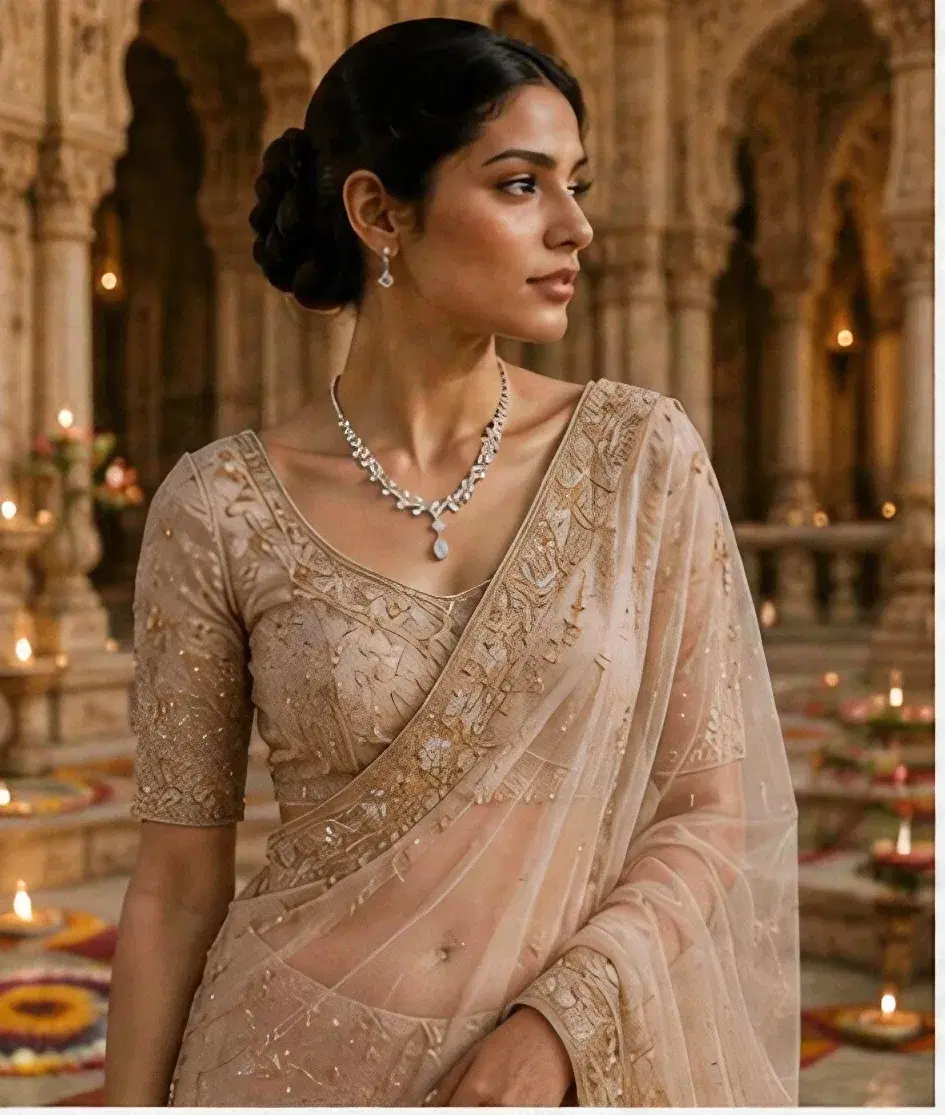
Where generation pays off fastest for Indian brands
- Marketplace depth: Amazon, Flipkart, Myntra, and quick-commerce listings each want multiple angles and lifestyle frames per SKU, coverage that at ₹500 per shot simply never happened for full catalogs.
- Festive refresh: Diwali, Akshaya Tritiya, and wedding-season creative regenerated annually, in multiple regional aesthetics, for less than one traditional shoot day.
- Regional variation: the same collection presented in North Indian bridal styling and South Indian temple styling, without two productions.
- Try-before-you-stock: campaign imagery for designs still in production, letting pre-orders test demand before inventory exists.
- D2C content velocity: Instagram and ad creative refreshed weekly rather than quarterly, which Indian D2C jewellery competes on whether it wants to or not.
A realistic 2026 budget for an Indian jewellery brand
For a mid-size brand with a 150-SKU catalog and festive campaigns: the pre-AI pattern was roughly ₹1 to 1.5 lakh annually on e-commerce photography (shooting perhaps half the catalog), plus ₹3 to 6 lakh for one campaign production, call it ₹5 to 7 lakh, with most SKUs never getting lifestyle imagery at all. The hybrid pattern replacing it: full-catalog AI coverage plus generated campaign creative across regions and festivals for well under ₹1 lakh annually, and a reserved ₹1 to 2 lakh studio budget for one hero production where physical craft is the story. Total spend halves; image volume grows tenfold; every SKU finally has campaign-grade imagery.
The global version of this comparison, in dollars and with the full hidden-cost breakdown, is in our companion piece on studio vs AI photography costs, and the complete how-it-works guide lives at AI product photography for jewellery brands. If seeing your own pieces is faster than reading about it, , bring the kundan set.
Frequently asked questions
- How much does a jewellery photoshoot cost in India in 2026?
- E-commerce pack shots run ₹200, ₹800 per image; model shoot days ₹15,000, ₹80,000; full campaign productions ₹2 to 8 lakh depending on scale and model tier. AI photoshoots range from roughly ₹30, ₹100 per image at the volume end to higher per-image pricing for commerce-grade fidelity, still a small fraction of studio rates.
- Are cheap AI jewellery photoshoot tools (₹30 to 100 per image) good enough?
- For simple pieces and marketplace thumbnails, often yes. For kundan, polki, bridal, and multi-stone pieces, where Indian jewellery is hardest, budget tools commonly lose stones, alter patterns, or flatten craftsmanship detail. Test any tool with your most complex bridal piece before committing a catalog to it.
- Can AI handle traditional Indian jewellery styles like kundan and polki?
- Only tools built with geometry-anchored product fidelity can. Dense stone maps, uncut polki facets, and meenakari detail defeat generic models. This capability gap, not price, is the real dividing line in the Indian market.
- Is AI photography accepted on Indian marketplaces like Flipkart, Myntra and Amazon?
- Yes, marketplaces care that imagery accurately represents the product and meets format guidelines, not how it was produced. Accuracy remains your responsibility, which is another reason fidelity matters more than per-image price.
- What should a jewellery brand still shoot traditionally?
- Craft and workshop storytelling, certification photography, and one hero campaign where physical production is part of the brand narrative. A common 2026 budget reserves ₹1 to 2 lakh for that and covers everything else with generation.